 |
| Quickly basking (SPOILER, new tank) |
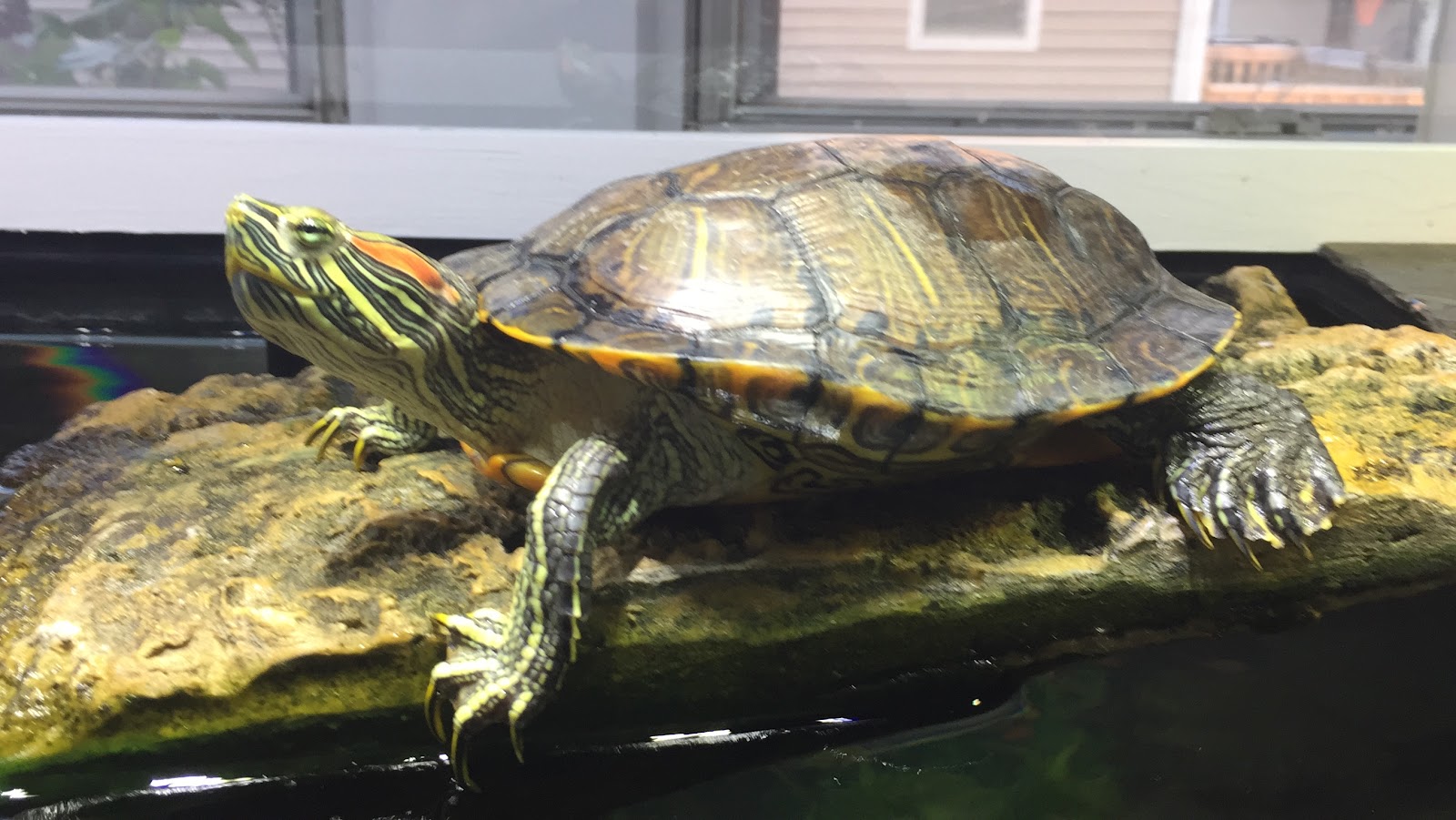
This is Quickly, my wife's very chill red-eared slider. She's had him about 10 years now... Longer than she and I have known each other. He's likely to live another 30. There's a story behind his name, but I'll leave that for her to tell.
When I met Quickly, he was living in a 20 gallon aquarium, and had outgrown it. When we moved in together, we upsized him to a 50 gallon tank. That seemed like plenty. But he kept growing, and we began to realize that he really didn't have enough space, the tank was difficult to keep clean (turtles are messy!) and he didn't have any stimulation. This became really apparent when we moved his tank out of the den during some renovations. He was right there with us as we'd eat dinner, and we started to plan a new tank.
 |
Here he is in his 50 gallon tank.
Not enough space for a turtle. |
We researched all sorts of tanks, and went so far as to purchase a 100 gallon black rubbermaid tank to build a habitat. But having him in with us during renovation really made us aware that he had a personality, and we wanted to see him. So we began looking at options for the largest glass tank we could fit into our den, and we'd knock a hole in the wall so we could see him. The largest tank we could fit was going to be 6 feet by 3 feet, and hold about 270 gallons. After pricing all that out for a while, realizing it would have to be a custom tank, we turned it down a notch. Gemma found a used 180 gallon tank (2 feet front to back instead of 3) in Astoria, I managed to wrangle that ~400 pound tank into the trusty minivan, and home I went. And then back again, to pick up the stand.
 |
Steel stand in process of being
sanded and repainted |
The stand was steel, and looked fine... At night. In light of day, as I was sanding and repainting, I realized that this was something some welder had tacked together. I needed this to handle more than 2000 pounds of glass and water, as well as not crack the slate flooring in the den, so I decided I'd have to build my own stand. I'll probably turn the steel one into a garage workbench or something.
I planned to drill the tank for overflows (I'm a reef guy at heart) and have a sump, so I needed to get that done first. I've drilled holes in tanks a few times before, but never something this big (or expensive). But the standard stuff about drilling glass applied, going slow, don't push, etc, etc. I have a right-angle Milwaukee drill that is about 200x overmatched for this job, so that was obviously the one I used!
 |
| Like a donut hole, but glass |
 |
| Big drill w/ diamond bit |
 |
| Three holes, zero cracked tanks |
Alright! Three holes, no cracks, things looking good! Previous owner had painted the back glass black, I removed that. You'll notice the leaves on the driveway, this is October of 2015. This project took a very long time, and I am very happy that it took its sweet time to snow that year! Since I wasn't liking the stand that I'd received along with this tank, I had to build my own. I was comfortable building a strong stand. The 240 gallon reef tank I built in 2011 is doing fine, the stand is rock solid, the engineermanship is sound. But that stand is hidden, built into a wall, and not finished in any sort of furniture-grade style. This one would need to be. Furthermore, we wanted the maximum amount of swimming area for Quickly, so his basking area would be above the main tank.
 |
| Sketchup makes neat drawings! |
So the plan I came up with was a standard 2x4 construction stand, just like the one I'd built before, but this time wrapped with a craftsman-style veneer. The back would be open. The glass above the main tank is 11 inches high, and there to keep Quickly from climbing out and cracking himself into pieces on the stone floor. His basking platform would be on the right hand third of the tank.
The previous owner of the tank had included the terrible metal stand, which takes up space in my driveway even as I type this, but he'd also given me a 4 foot LED lighting fixture. Not enough to grow plants, but enough to light the tank not under the basking platform. Basically, perfect for a turtle tank.
Again, thanks Mother Nature for not snowing me in and preventing this build!
 |
2x4 and 2x8 construction, sheathed
in plywood. The plywood on the back
extends down about 12". |
If you follow along closely later on, you'll notice that the original design had the doors coming together with a very narrow separator. The entire front was going to be openable, no supports. I second-guessed this later in the process and added a middle support. Very likely not needed, but I'm not disappointed with the final result, and it is definitely not going to sag. So the doors have a 3" margin between them.

The doors are glued and pocket-screwed together, with the center panel dadoed to accept some pine paneling pieces. I really like how these came out.
The tricky part was cutting the plywood that I planned to use on the front of the cabinet to accept these panels. I initially tried using a thin-kerf circular saw, but found that the blade wandered enough to absolutely wreck the cut out, and I had to start over. Similar variances happened when I tested using a jigsaw and a regular kerf saw. Starting fresh, I ended up creating a jig and then using a router with a bearing to follow the jig and cut the opening PERFECTLY. Should have done it that way to start.
 |
| Hallelujah, perfect fit! |
The top of the stand was a challenge, more for sourcing the correct materials than for any complicated cutting. I wanted it to be at least 1.5" thick and solid wood. I ended up getting several .75" boards and gluing them up.
That almost immediately failed, as the boards began to dry out unevenly and cupped up like crazy. Then I weighted the top down with buckets of water overnight to straighten the top out, one bucket leaked, dissolved the glue, and the piece came apart. That was... Frustrating.
So back to the hardware store I went, and purchased a flat, solid wood door. The door was about 18" too long, so I sliced it down. Turns out 'solid wood' is one of those marketing terms. Yes, what was inside that door is technically wood, in the same sense that a hotdog is technically beef. It was a very chippy, sawdusty mess! So I then had to cut it down more and attach a 'real wood' end and back piece. Wouldn't matter for looks, as it was being painted, but it sure did put me in a bad mood, as I was probably about $400 into wood just for the stand top, and it was taking weeks to get it ready. But then, just like that, it was done!
 |
Waddya mean we need to
get this into the house? |
OK, not exactly done, but it sure looks like a stand now, don't you think? Since this was getting painted, I just screwed straight through the plywood into the 2x4 frame. The 2x4s carry the load, and the plywood prevents them from racking sideways under load. The screws would be covered over. The strap hinges are great, I love them.
 |
Looking in from outside...
Tank stand! |
Finally, on December 21, 2015, I got the tank stand into the house with its first coat of paint. This about two and a half months after Gemma first found the tank, so this project is not proceeding quickly (pardon the pun), but it's moving. Next step, shore up the floor. The last thing we want is this tank to land up next to the saltwater tank in the basement.

All told, the tank plus stand plus water plus rocks plus sump plus whatever was going to approach 3000 pounds. I knew the direction of the
joists, their span, etc. The tank is only a few feet from a foundation wall. It's unlikely that there would be a problem even if I did nothing. BUT, it's perched on a stone floor, and even a little flex is likely to crack the slate. So I added a 4x4 reinforcement to the basement below the tank. It's belt and suspenders.
Or I hope it is!
It took until January 10 before it was finally time to wrassle the tank into the house. No white Christmas this year, no snow to speak of. Last year the tank would have been under a foot of ice and snow, but not this time. I'd managed to find my suction-based lifting handles, so the wrangling wasn't nearly as bad as getting the thing into and out of the minivan. But finally, the tank was in the house, no more worries about the weather, and phase two could commence!
 |
Leak check! Buying on Craiglist and not testing
anything for three months could have gone - badly. All OK! |
Part 2 to follow!




 The doors are glued and pocket-screwed together, with the center panel dadoed to accept some pine paneling pieces. I really like how these came out.


 All told, the tank plus stand plus water plus rocks plus sump plus whatever was going to approach 3000 pounds. I knew the direction of the


 Tunze 5017 Water Level Controller: The basic brains of the controller system. It is hard-wired to the optical and float-switch sensors, with a shortish wire with a strange electrical connector at the end (more on that further down) for the pump. The power supply plugs into the bottom of the controller. Four lights tell you what's going on: A green LED is usually shown, when the system is balanced. If you fiddle with the optical sensor, you'll see this light blink on and off as it detects happy/sad water status. If the optical sensor stays off for long enough (about 2 seconds), the pump will switch on for a minimum of 10 seconds, along with a yellow LED indicating active pumping.
  Optical (IR) Waterlevel Sensor: This is a pretty fancy little gadget. As you can see from the picture, it has a slightly pointed tip that points down into the water. What you can't see from the image is that the tip is clear, with an LED package on either side. Actually, I'm guessing that one is an IR LED, the other is an IR detector. My uneducated guess is that when water contacts the bottom of this, it essentially causes the light being emitted by the LED to be channelled to the sensor, much the same way as fiber optics channel light by bouncing it off the interface between materials of different refractive indices. Anyways, that doesn't matter. Whenever water touches the tip, the Osmolator is happy. When it doesn't, the Osmolator is sad. Since there are no moving parts, this sensor should be very reliable. I'll have to see if over time any sort of salt crust develops. If it does, I'm sure just rubbing the sensor would fix any mischief.
  Magnetic Float Switch: This switch is your panic/cutoff. If for some reason the optical sensor doesn't register that the water has been replenished, the float switch will both cut the pump and sound an alarm. A constant beep tone. It's annoying, but it wouldn't wake me up, it's not very loud. But if I were awake, I'd likely hear it and try to do something about it. This is really the last safety, because if the system fills to the point that this alarm triggers, you've probably got a MASSIVE failure and your tank is siphoning into your sump or something equally evil, and if that is the case, it's probably power-failure-related, and if that's the case, this alarm won't be working because the Osmolator doesn't have a battery backup, and it won't have been the pump's fault anyways, because there's no power! But it's a nice thought.
  Water pump: The final piece of the puzzle. Just a normal pump. Has a power lead coming off it that hooks to the strange connector from the controller. When I say 'strange,' I mean 'poorly designed.' Instead of having a standard 'plug,' the end of the pump wire just has two stripped wires. You have to then screw these wires into terminals on the wire coming from the controller. It makes me uneasy to have bare wire near salt water. I may replace this in the future with some sort of real plug, or just solder the wires and seal them with heat-shrink. Low voltage or not, shorting the wire would NOT be a good thing. Also, I'd like it if the pump was either A) weighted at the bottom or B) had suction-cup feet. As you can see from the picture, the pump is tall and skinny. And top-heavy.